Touch Ignites Physical Intelligence: Xense Robotics Showcases The Real Ability Of Tactile Intelligence At ICRA 2026
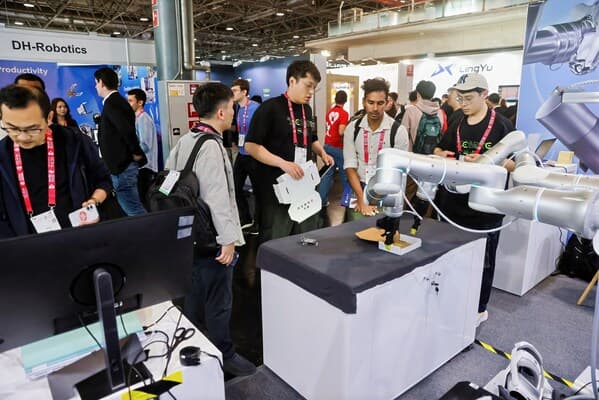
Xense Robotics Technology (Shanghai) Co., Ltd. presented its full-stack tactile intelligence technology system at the IEEE International Conference on Robotics and Automation (ICRA 2026) in Vienna, Austria. Held from June 2 to June 4, 2026, the exhibition highlighted the company's core proposition, "Touch Ignites Physical Intelligence," featuring a comprehensive display of tactile hardware perception, data acquisition, and VTLA models. The centerpiece of the demonstration was a VTLA model-driven dual-arm long-horizon autonomous carton-forming operation. Unlike traditional fixed-trajectory programming, this solution relied entirely on real-time tactile and visual feedback to manage flexible materials. The robot successfully adapted to dynamic contact states, such as slippage and deformation, without manually preset trajectories, proving the viability of active perception in complex physical tasks. Alongside the operational demo, Xense Robotics debuted the TacCap-Gripper, a wearable two-finger tactile data acquisition device integrating visuo-tactile sensors and IMU units. The company also exhibited a complete product matrix of multimodal tactile sensors adaptable to various carriers, including dexterous hands and industrial arms. These tools aim to close the data loop for robotic physical interaction by capturing micro-level information like pressure distribution and force fluctuations. To validate the sensitivity of their technology, the booth featured a lightweight interactive experience area using planar tactile sensors for real-time game control. Xense Robotics emphasized that next-generation embodied intelligence requires combining visual cognition with tactile perception to achieve reliable task completion in unstructured scenarios. The company plans to continue iterating on sensing hardware and algorithms to support large-scale real-world deployment. Xense Robotics successfully validated tactile-driven manipulation in complex scenarios during ICRA 2026, addressing the limitations of vision-only systems in physical interaction. This development is significant because it provides a technical pathway for robots to handle unstructured environments where force and deformation data are critical for success. While the technology demonstrates high sensitivity, widespread industrial adoption depends on cost reduction and long-term durability testing. The company aims to expand this capability across humanoid and industrial platforms, though market penetration timelines remain uncertain.