
The Strategic Intersection of Artificial Intelligence and Modern Business Operations - QUE. com
In the rapidly evolving landscape of 2026, business operations have shifted from deterministic software to probabilistic intelligence, marking a move beyond simple automation toward cognitive orchestration. Organizations are now leveraging Large Language Models to redesign how value is created, with marketing transforming from broad-casting to narrow-casting precision tools. Through real-time behavioral analysis, companies achieve hyper-personalization at scale, managing the customer journey with machine efficiency and human-like nuance. Internally, the rise of the autonomous supply chain allows businesses to anticipate demand shifts before they occur. By integrating Machine Learning with IoT-enabled warehouses, firms are transitioning toward Zero-Inventory strategies that eliminate storage overhead costs. The most successful entities have adopted a collaborative model where AI handles data processing while humans provide strategic oversight and ethical judgment. This augmented intelligence approach ensures high-quality output resonates emotionally with brand identity. As AI becomes pervasive, the currency of the modern business world has shifted from information to trust. Companies implementing AI Ethics Boards and rigorous auditing processes gain a competitive advantage in the emerging Trust Economy. Looking ahead, the trajectory points toward the Fully Cognitive Organization, where the business functions as a learning organism that optimizes its own structure in real-time based on feedback loops. The primary takeaway is that artificial intelligence has evolved from a task automation tool into a strategic imperative for organizational design. This shift significantly alters competitive dynamics by enabling real-time operational pivots and deep personalization. However, the long-term success of these systems depends heavily on maintaining transparent ethical governance to sustain customer trust. Uncertainty remains regarding the speed of adoption across industries with legacy infrastructure.
Anzeigenöffentlicht: June 10, 2026 at 06:09 PM
News Article
Inhalt
In the rapidly evolving landscape of 2026, business operations have shifted from deterministic software to probabilistic intelligence, marking a move beyond simple automation toward cognitive orchestration.
Organizations are now leveraging Large Language Models to redesign how value is created, with marketing transforming from broad-casting to narrow-casting precision tools. Through real-time behavioral analysis, companies achieve hyper-personalization at scale, managing the customer journey with machine efficiency and human-like nuance.
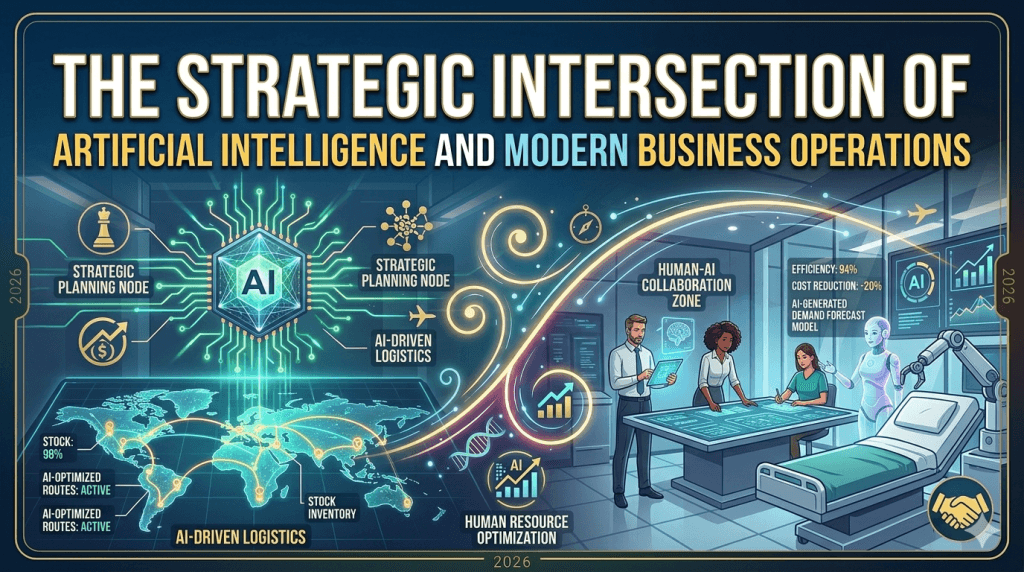
Internally, the rise of the autonomous supply chain allows businesses to anticipate demand shifts before they occur. By integrating Machine Learning with IoT-enabled warehouses, firms are transitioning toward Zero-Inventory strategies that eliminate storage overhead costs.
The most successful entities have adopted a collaborative model where AI handles data processing while humans provide strategic oversight and ethical judgment. This augmented intelligence approach ensures high-quality output resonates emotionally with brand identity.
As AI becomes pervasive, the currency of the modern business world has shifted from information to trust. Companies implementing AI Ethics Boards and rigorous auditing processes gain a competitive advantage in the emerging Trust Economy.
Looking ahead, the trajectory points toward the Fully Cognitive Organization, where the business functions as a learning organism that optimizes its own structure in real-time based on feedback loops.
Wichtige Erkenntnisse
The primary takeaway is that artificial intelligence has evolved from a task automation tool into a strategic imperative for organizational design.
This shift significantly alters competitive dynamics by enabling real-time operational pivots and deep personalization.
However, the long-term success of these systems depends heavily on maintaining transparent ethical governance to sustain customer trust.
Uncertainty remains regarding the speed of adoption across industries with legacy infrastructure.