
The Cognitive Epoch: How Artificial Intelligence is Redefining Reality in 2026 - QUE. com
As the world navigates the mid-point of the 2020s, historians and technologists confirm the official arrival of the Cognitive Epoch. The defining characteristic of 2026 is the seismic rupture in how society perceives labor and intelligence, marking the transition from Artificial Intelligence as a tool to AI as an autonomous collaborator. For years, the focus remained on Generative AI systems capable of writing poetry or summarizing documents. Now, the industry has matured into Agentic AI, where systems operate on goals rather than waiting for prompts. Enterprises deploy AI Ecosystems where a primary orchestrator manages specialized agents to execute complex projects without human intervention, such as a Growth Agent analyzing market trends and launching ad campaigns autonomously. Concurrently, Large Language Models have converged with advanced robotics to create Physical Intelligence. These entities integrate AI brains into humanoid forms with dexterity previously unseen, utilizing imitation learning to perform tasks ranging from folding laundry to managing warehouse logistics. The boundary between digital intelligence and physical action has effectively vanished. The economic landscape presents a paradox of abundance versus displacement. While the cost of intelligence has plummeted, democratizing expertise for small startups, entry-level roles in law and software engineering have nearly disappeared. This has sparked global conversations regarding Universal Basic Income and the necessity of valuing empathy over technical proficiency. Ethical challenges center on Synthetic Truth, where AI-generated media is indistinguishable from reality. Governments face a Verification Crisis requiring cryptographic provenance for digital content. Looking ahead, the debate on Artificial General Intelligence has shifted to when it will arrive, with early signs of recursive self-improvement indicating a move toward Distributed Intelligence. The primary shift in 2026 is the operational maturity of agentic AI, moving beyond prompt-response to goal-driven autonomy. This transition signifies a structural change in global labor markets where technical proficiency is increasingly secondary to strategic orchestration. While productivity gains are evident, the timeline for achieving Artificial General Intelligence remains uncertain despite early signs of recursive self-improvement. Policymakers must address the verification crisis regarding synthetic media before trust in digital information erodes further.
Anzeigenöffentlicht: June 18, 2026 at 03:21 PM
News Article
Inhalt
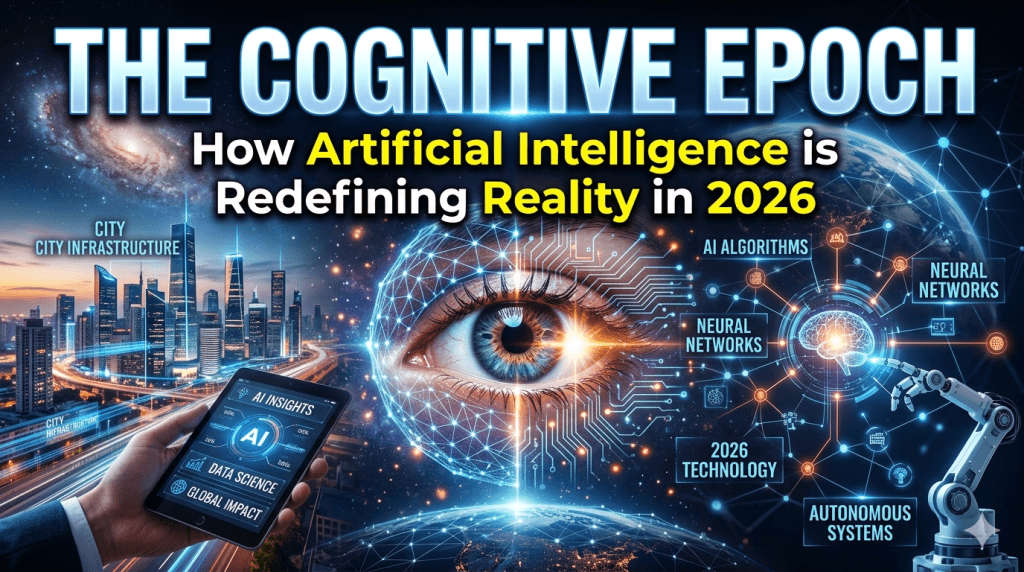
As the world navigates the mid-point of the 2020s, historians and technologists confirm the official arrival of the Cognitive Epoch. The defining characteristic of 2026 is the seismic rupture in how society perceives labor and intelligence, marking the transition from Artificial Intelligence as a tool to AI as an autonomous collaborator.
For years, the focus remained on Generative AI systems capable of writing poetry or summarizing documents. Now, the industry has matured into Agentic AI, where systems operate on goals rather than waiting for prompts. Enterprises deploy AI Ecosystems where a primary orchestrator manages specialized agents to execute complex projects without human intervention, such as a Growth Agent analyzing market trends and launching ad campaigns autonomously.
Concurrently, Large Language Models have converged with advanced robotics to create Physical Intelligence. These entities integrate AI brains into humanoid forms with dexterity previously unseen, utilizing imitation learning to perform tasks ranging from folding laundry to managing warehouse logistics. The boundary between digital intelligence and physical action has effectively vanished.
The economic landscape presents a paradox of abundance versus displacement. While the cost of intelligence has plummeted, democratizing expertise for small startups, entry-level roles in law and software engineering have nearly disappeared. This has sparked global conversations regarding Universal Basic Income and the necessity of valuing empathy over technical proficiency.
Ethical challenges center on Synthetic Truth, where AI-generated media is indistinguishable from reality. Governments face a Verification Crisis requiring cryptographic provenance for digital content. Looking ahead, the debate on Artificial General Intelligence has shifted to when it will arrive, with early signs of recursive self-improvement indicating a move toward Distributed Intelligence.
Wichtige Erkenntnisse
The primary shift in 2026 is the operational maturity of agentic AI, moving beyond prompt-response to goal-driven autonomy.
This transition signifies a structural change in global labor markets where technical proficiency is increasingly secondary to strategic orchestration.
While productivity gains are evident, the timeline for achieving Artificial General Intelligence remains uncertain despite early signs of recursive self-improvement.
Policymakers must address the verification crisis regarding synthetic media before trust in digital information erodes further.